


The Buyer's Cycle Framework
What It Is and Why Most B2B Sales Teams Don't Have One
Most established B2B businesses have the pieces. A sales team. A CRM full of contacts. A history of client work good enough to point to in a pitch. What they don’t have is anything that reliably turns interest into a qualified conversation without someone manually chasing it down.
That gap rarely shows up as a crisis. It shows up as inconsistency: a strong quarter followed by a quiet one, a pipeline report that looks fine until you ask how many of those deals actually originated from something the business did on purpose. Ask most B2B leaders where their best leads come from, and the honest answer is referrals, plus whatever the sales team manages to keep warm in their own heads. There’s a sales team. There’s a CRM. There’s no system connecting the two.
Why the Sales Funnel Breaks Down for Long-Cycle B2B
The funnel model assumes a straight line: awareness, interest, decision, action, moving in one direction on a timeline the seller controls. That holds up reasonably well for low-consideration purchases. It doesn’t hold for high-ticket B2B, where the buying committee can grow halfway through the process, budget approval resets the timeline without warning, and a genuinely interested buyer can go quiet for three months while they deal with something else entirely, then resurface ready to talk.
If a business treats that quiet period as a leak, the pipeline data reads as the funnel working, deals just falling out the bottom. But it isn’t a leak. It’s a loop. The buyer didn’t fall through. They’re circling, waiting for their internal priorities to line up with what’s actually being offered. A system built on a straight line has no way to catch them when they come back around, so most businesses just don’t. They start from zero with the next inbound lead instead.
What the Buyer’s Cycle Framework Actually Is
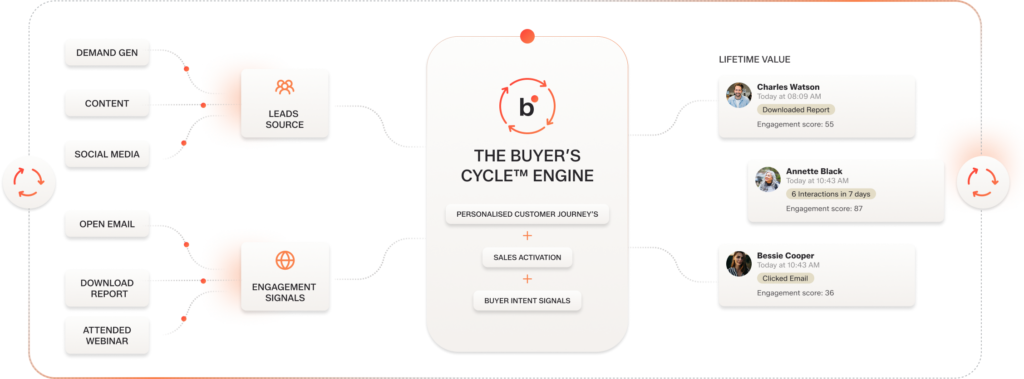
The Buyer’s Cycle Framework is a closed-loop lead system built specifically for long-cycle, high-ticket B2B sales. Instead of pushing every contact toward an immediate decision, it runs on four connected functions:
- Capture interest as it appears. Not just when someone fills out a form, but at the point they first show up, a content download, a pricing page visit, a return after months away.
- Read buying signals as they happen. A second visit to a pricing page, a re-download of a case study, an open on an email that’s been ignored for weeks, these are data, not noise.
- Nurture with follow-up that’s actually personalised. Relevant to where that specific buyer is in their process, not a generic drip sequence firing on a fixed schedule regardless of behaviour.
- Hand off a sales-ready lead at the right moment. When the signals say they’re ready to talk, not before, and not so late that a competitor gets there first.
In short: the Buyer’s Cycle Framework captures interest, reads the signals, nurtures with relevant follow-up, and delivers a sales-ready lead when the buyer is actually ready, not when a calendar says they should be.
Why It’s a Cycle, Not a Funnel
The name is deliberate. A funnel treats a buyer who goes quiet as lost. A cycle treats them as re-entered. When a buyer’s signals change, a return visit, a competitor’s RFP forcing a decision, a new budget cycle opening up, they get picked back up automatically, at the stage their behaviour actually puts them in, not back at square one.
That’s the structural difference. Most B2B marketing spends its entire effort trying to prevent buyers from going quiet. The Buyer’s Cycle assumes they will, because on an eighteen-month enterprise sale, they always do, and builds the system around bringing them back in rather than treating their silence as a failure to be avoided.
Why This Matters More Than Another Ad Campaign
Ads and referrals are both good at one thing: generating initial interest. Neither is built to do anything with that interest once it goes quiet. Without a system behind them, every new lead from every new campaign starts the relationship from zero, and whatever ground was covered with a buyer who didn’t convert the first time is lost the moment the campaign ends.
The Buyer’s Cycle is the layer that makes those channels compound instead of resetting. A lead that came in from a paid campaign eight months ago and went quiet isn’t gone, they’re sitting in the loop, waiting for a signal. When that signal shows up, the business is already positioned as the name they recognise, not a cold introduction competing from scratch against whoever else is in the room by then.
What This Looks Like in Practice
When Forpoint Solutions rebuilt their go-to-market system with Born Digital, the result wasn’t a single campaign spike. It was a consistent, repeatable flow: organic traffic grew from a near-standing start to over 1,000 unique visitors a month, generating 15 qualified leads a week, week after week, not as a one-off result but as the ongoing output of a system built to keep running.
That’s the point of a closed-loop system over a campaign-based one. A campaign produces a result once. A system produces the result again, and again, without needing to be rebuilt from scratch every quarter.
Build This for Your Business
If your business has the sales team and the CRM but not the system connecting them, the Buyer’s Cycle is the piece that’s missing. The starting point is a Strategy Session: a focused, fixed-cost engagement where we map where your buyers are stalling, going quiet, or falling back on referrals to move forward, and build the roadmap to close that gap.
Book a Strategy Session to see what this looks like for your pipeline specifically.